Part 1: Understanding the New FRS 102 Lease Rules
An easy-to-understand guide for business owners, directors and finance teams.
If your business rents its premises, leases vehicles or uses equipment under a lease agreement, changes to UK accounting rules could have a significant impact on your financial statements.
The Financial Reporting Council (FRC) has updated FRS 102, the main accounting standard used by many UK businesses. One of the most important changes relates to how leases are accounted for.
Previously, many businesses could record their rental payments as an expense without showing the full commitment on their balance sheet. Under the new rules, this is changing.
So, what does this mean in practice? And what should your business be doing now?
Let's break it down.
1. What is changing under FRS 102?
FRS 102 is an accounting standard that sets out how many UK businesses prepare their financial statements.
The revised lease accounting rules apply to accounting periods beginning on or after 1 January 2026, although early adoption is permitted in certain circumstances.
The key change is that businesses renting property, vehicles or equipment will generally need to show the value of their lease commitments on the balance sheet.
FRS 102 - What happened before and what happens now?
Previously:
Many rental agreements were treated as operating leases. Rental payments were generally recorded as an expense in the profit and loss account, with future commitments disclosed in the notes to the accounts.
Under the revised rules:
Most leases will be recognised on the balance sheet as a right-of-use asset and a corresponding lease liability. Instead of recording one rental expense, the business will generally record depreciation and interest charges.
In simple terms, the accounts will provide a clearer picture of the assets a business has the right to use and the future payments it is committed to making.
2. What is a right-of-use asset?
This sounds technical, but the concept is straightforward.
Imagine your business rents an office for five years. You do not own the office, but your lease gives you the right to use it for the agreed period.
Under the new rules, that right is recognised as an asset in your accounts. At the same time, the obligation to make future lease payments is recognised as a liability.
The same principle can apply to leased vans, machinery, shop premises and other qualifying assets.
The important point: recognising an asset does not mean you own the underlying property or equipment. It means you have a contractual right to use it.
3. A simple example: renting business premises
Let's say your business rents its premises for five years, with annual rental payments of £24,000.
That means the business has agreed to pay £120,000 in rent over the five-year term, assuming the rent remains unchanged.
Under the previous accounting rules, if the lease was classified as an operating lease, the business would typically record £24,000 as a rental expense each year.
Under the revised rules, the business will generally recognise a lease asset and a lease liability at the start of the lease, measured using the relevant accounting requirements. The calculation takes account of factors such as the timing of payments and an appropriate discount rate.
The following table illustrates the difference in approach. The figures are simplified and do not represent a complete lease calculation.
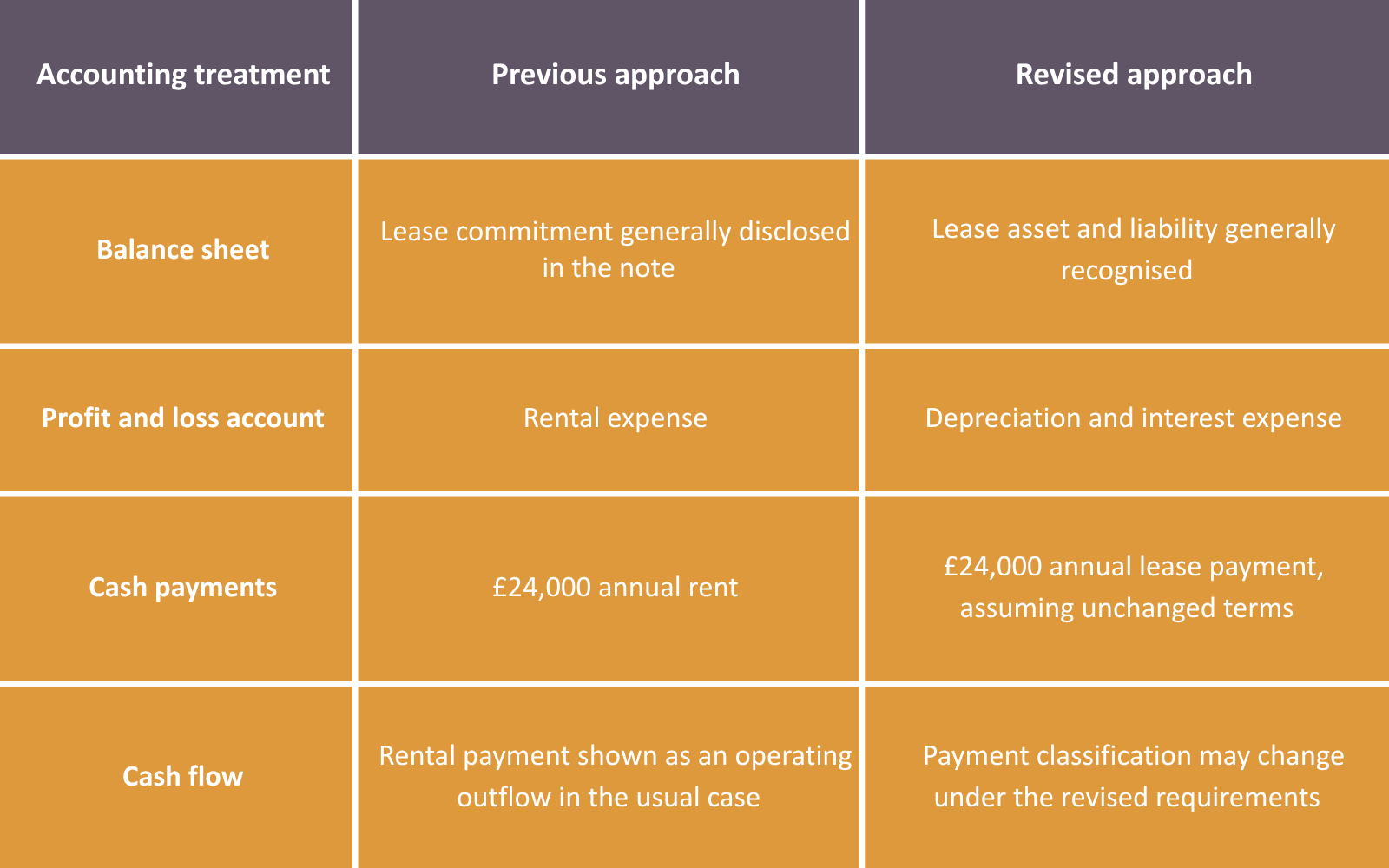
The key takeaway is that the accounting changes, but the contractual rent does not automatically change. Your landlord does not become entitled to charge more simply because the accounting standard has changed.
Look out for Part 2, which we will be publishing soon as a separate LinkedIn article. We will explore what these changes could mean for your business in practice, including the potential impact on your balance sheet, reported profits, EBITDA and borrowing arrangements. We will also cover the available exemptions, possible tax considerations and the practical steps you can take now to prepare for the revised requirements. Subscribe to our LinkedIn newsletter or follow our page to make sure you don’t miss it.
Disclaimer: This article is intended for general information purposes only and does not constitute accounting, tax or legal advice. The treatment of individual leases depends on the applicable accounting requirements and the specific contract terms. Please consult your professional adviser about your circumstances.
We provide innovative tax, accountancy and business advice to our clients throughout the North East. If you would like advice regarding anything mentioned in this newsletter, or any other accountancy matter, please contact a member of our team.
Keep Informed
Sign up here to receive our regular blogs with news, advice and updates on a wide range of issues affecting businesses and individuals.
The information provided in this blog is for general informational purposes only and should not be considered professional advice. As far as we are aware, the content is accurate at time of publication. Torgersens assumes no responsibility for errors or omissions in the content or for any actions taken based on the information provided.